

How to Know When to Sell
Having a plan for selling your stocks is critical to your portfolio’s success.
Having a plan for selling your stocks is critical to your portfolio’s success.
Having a plan for selling your stocks is critical to your portfolio’s success.
Buying a stock is fun, a positive event. It is the beginning of a hopeful relationship. Selling is a negative experience, the end of the relationship. Selling is not fun, but it must be done.
Without a plan, you typically make your selling decisions based on emotional factors.

How to Know When to Sell
Having a plan for selling your stocks is critical to your portfolio’s success.
Having a plan for selling your stocks is critical to your portfolio’s success.
Buying a stock is fun, a positive event. It is the beginning of a hopeful relationship. Selling is a negative experience, the end of the relationship. Selling is not fun, but it must be done.
Without a plan, you typically make your selling decisions based on emotional factors.
Your Stop Price
Where do you set your stop?
Successful Investors will make sure to use a…
Successful Investors will make sure to use a…
In a previous training, we discussed how to determine what makes a stock safe. If you missed it, check it out here.
Be Careful: It’s commonly taught to use a universal stop for every stock, such as a trailing stop. While this may sound easy, this arbitrary percentage does not take into account the stock’s safety and may fall within the stock’s normal trading range causing you to sell a stock too early. (i.e. the stop is too tight)
Here at VectorVest, we calculate a STOP price for every stock we track.
Our STOP price is based on a 13-week moving average, but we adjust it based on the fundamentals of the company.
It automatically gives your stock the appropriate amount of room it needs to “breathe.”
•
Tighter Stop on Riskier Stocks
•
Wider Stop on Safer Stocks
•
It is purely mathematical.
•
No personal opinions.
•
No hidden agendas.
• Tighter Stop on Riskier Stocks
• Wider Stop on Safer Stocks
In a previous training, we discussed how to determine what makes a stock safe. If you missed it, check it out here.
Be Careful: It’s commonly taught to use a universal stop for every stock, such as a trailing stop. While this may sound easy, this arbitrary percentage does not take into account the stock’s safety and may fall within the stock’s normal trading range causing you to sell a stock too early. (i.e. the stop is too tight)
Here at VectorVest, we calculate a STOP price for every stock we track.
• It is purely mathematical.
• No personal opinions.
• No hidden agendas.
Our STOP price is based on a 13-week moving average, but we adjust it based on the fundamentals of the company.
Poor Fundamentals = Riskier Company = Tighter Stop
Good Fundamentals = Safer Company = Wider Stop
Poor Fundamentals = Riskier Company = Tighter Stop
Good Fundamentals = Safer Company = Wider Stop
It automatically gives your stock the appropriate amount of room it needs to “breathe.”
2 Keys to Setting Stops Correctly
2 Keys to Setting Stops Correctly

Key Point #1:
Give your stock “room to breathe.”
Your stop should give the stock enough room to do its normal trading action.
Think of it like lanes on the highway.
Tight, Narrow Lane – Stressful driving. You cross over the line in your normal driving. Not because you were driving erratically; you just crossed the lines because they were too tight.
Wider Lane – Relaxed driving. Allows you to do the normal ebbs & flows of driving. If you do cross over the line, and you hit those bumps on the side of the road, you know something is definitely wrong.
What about your trades?
Tight, Suffocating Stop – Stressful investing. You typically end up selling stocks too early resulting in several small losses. The stock wasn’t trading erratically; your stop was just too tight. Those small losses add up over time.
Wider Stop – Relaxed investing. Allows your stock to do its normal movement without hitting the stop. If it hits the stop, you know something abnormal has happened and you should exit the trade.
Tight, Narrow Lane – Stressful driving. You cross over the line in your normal driving. Not because you were driving erratically; you just crossed the lines because they were too tight.
Wider Lane – Relaxed driving. Allows you to do the normal ebbs & flows of driving. If you do cross over the line, and you hit those bumps on the side of the road, you know something is definitely wrong.
Tight, Suffocating Stop – Stressful investing. You typically end up selling stocks too early resulting in several small losses. The stock wasn’t trading erratically; your stop was just too tight. Those small losses add up over time.
Wider Stop – Relaxed investing. Allows your stock to do its normal movement without hitting the stop. If it hits the stop, you know something abnormal has happened and you should exit the trade.

Key Point #2:
Know your exits in advance.
The trade goes for you.
The trade goes against you.
Where to exit if the plane lands safely.
Where to exit if there is an emergency.
Just like when you get on a plane.
Before the plane moves, you learn:
Where to exit if the plane lands safely.
Where to exit if there is an emergency.
Where to exit if the plane lands safely.
Where to exit if there is an emergency.
Treat your trades the same way.
Know your exits before you enter the trade.
Have an exit plan in place if:
The trade goes for you. to exit if the plane lands safely.
The trade goes against you.
The trade goes for you. to exit if the plane lands safely.
The trade goes against you.
The trade goes for you.
The trade goes against you.
Where to exit if the plane lands safely.
Where to exit if there is an emergency.
The first thing you do is decide what your stop will be at the beginning of the trade. We call this your initial “Line In The Sand” (LITS).
This is the point where enough is enough, and if the stock’s price crosses this line, you exit the trade no questions asked.
The VectorVest STOP Price in Action
The VectorVest STOP is our proprietary indicator of when to sell a position which is based upon a stock’s safety, fundamentals and price trend.
It is more intelligent than a trailing stop because it is computed from a 13-week moving average of the stock’s closing prices and is fine-tuned according to the stock’s fundamentals. This means, by design, it will keep you in good, safe stocks longer than it would potentially dangerous, risky stocks.
The VectorVest STOP is one of the simplest exit plans to understand and implement because it is really easy to spot when a stock’s price falls below its Stop Price, thereby signaling a VectorVest SELL rating.
Take a look at the example below.
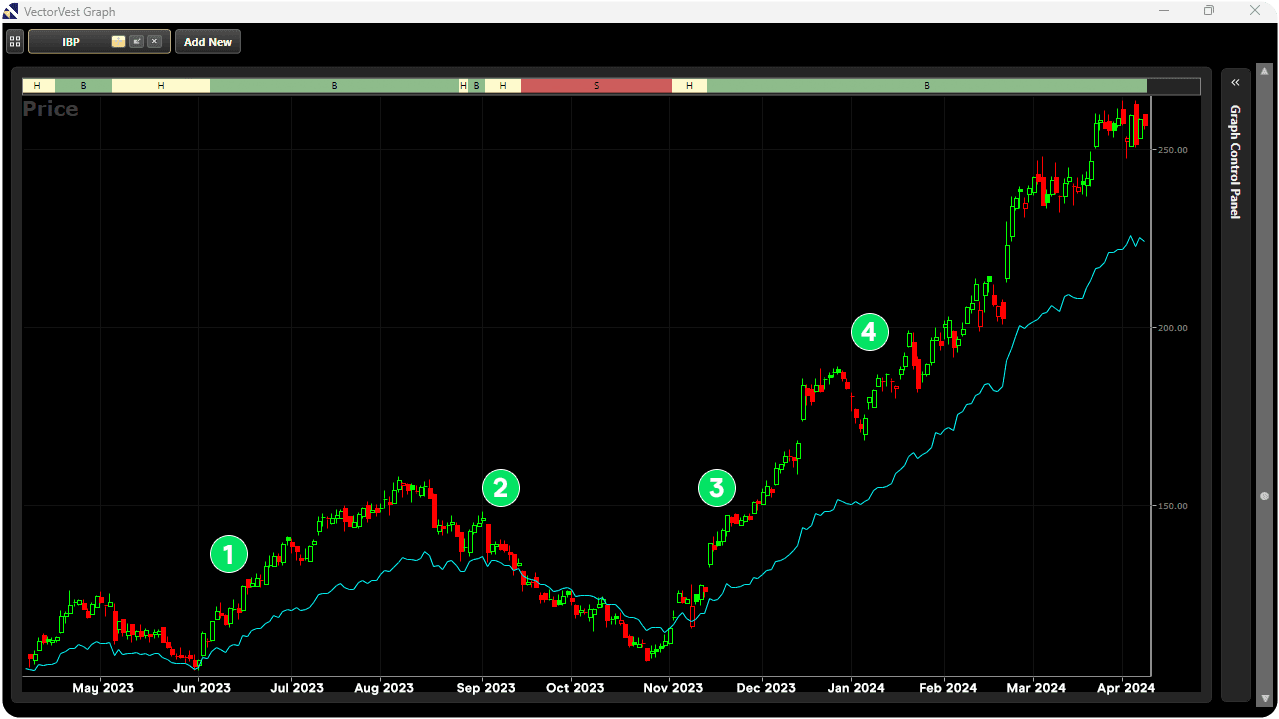
June 2023 – The VectorVest STOP price gave the stock enough room so you did not get stopped out, allowing you to benefit from the next uptrend.
Sept 2023 – A Sell rating was triggered when the price fell below the VectorVest STOP.
Nov 2023 – Distance between the stock’s price and STOP price widens indicating the stock price is behaving favorably and will likely continue to perform well.
Jan 2024 through Mar 2024 – The VectorVest STOP price once again gives the stock enough room to breathe allowing a winning trade to continue rising.
A stock’s price behavior and future performance can become vividly clear by observing the difference between a stock’s price and its Stop Price.
The VectorVest STOP Price in Action
The VectorVest STOP is our proprietary indicator of when to sell a position which is based upon a stock’s safety, fundamentals and price trend.
It is more intelligent than a trailing stop because it is computed from a 13-week moving average of the stock’s closing prices and is fine-tuned according to the stock’s fundamentals. This means, by design, it will keep you in good, safe stocks longer than it would potentially dangerous, risky stocks.
The VectorVest STOP is one of the simplest exit plans to understand and implement because it is really easy to spot when a stock’s price falls below its Stop Price, thereby signaling a VectorVest SELL rating.
Take a look at the example below.
The VectorVest STOP is our proprietary indicator of when to sell a position which is based upon a stock’s safety, fundamentals and price trend.
It is more intelligent than a trailing stop because it is computed from a 13-week moving average of the stock’s closing prices and is fine-tuned according to the stock’s fundamentals. This means, by design, it will keep you in good, safe stocks longer than it would potentially dangerous, risky stocks.
The VectorVest STOP is one of the simplest exit plans to understand and implement because it is really easy to spot when a stock’s price falls below its Stop Price, thereby signaling a VectorVest SELL rating.
Take a look at the example below.
June 2023 – The VectorVest STOP price gave the stock enough room so you did not get stopped out, allowing you to benefit from the next uptrend.
Sept 2023 – A Sell rating was triggered when the price fell below the VectorVest STOP.
Nov 2023 – Distance between the stock’s price and STOP price widens indicating the stock price is behaving favorably and will likely continue to perform well.
Jan 2024 through Mar 2024 – The VectorVest STOP price once again gives the stock enough room to breathe allowing a winning trade to continue rising.
June 2023 – The VectorVest STOP price gave the stock enough room so you did not get stopped out, allowing you to benefit from the next uptrend.
Sept 2023 – A Sell rating was triggered when the price fell below the VectorVest STOP.
Nov 2023 – Distance between the stock’s price and STOP price widens indicating the stock price is behaving favorably and will likely continue to perform well.
Jan 2024 through Mar 2024 – The VectorVest STOP price once again gives the stock enough room to breathe allowing a winning trade to continue rising.
June 2023 – The VectorVest STOP price gave the stock enough room so you did not get stopped out, allowing you to benefit from the next uptrend.
Sept 2023 – A Sell rating was triggered when the price fell below the VectorVest STOP.
Nov 2023 – Distance between the stock’s price and STOP price widens indicating the stock price is behaving favorably and will likely continue to perform well.
Jan 2024 through Mar 2024 – The VectorVest STOP price once again gives the stock enough room to breathe allowing a winning trade to continue rising.
A stock’s price behavior and future performance can become vividly clear by observing the difference between a stock’s price and its Stop Price.
A stock’s price behavior and future performance can become vividly clear by observing the difference between a stock’s price and its Stop Price.
Why This Matters To You
The cardinal rule of investing is to let your profits run and keep your losses small. The dynamic nature of the VectorVest Stop Price allows you to stay with solid stocks longer and get out of weak stocks sooner.
When you are deciding to sell a stock, you want to:
VectorVest helps you do all three with our one-of-a-kind STOP price.
Know your exit before you enter the trade.
Give your stocks room to breathe.
Remove emotional decisions.
Know your exit before you enter the trade.
Give your stocks room to breathe.
Remove emotional decisions.
Know your exit before you enter the trade
Give your stocks room to breathe.
Remove emotional decisions
VectorVest helps you do all three with our one-of-a-kind STOP price.
Anytime you’re ready, you can start a 30-day trial of our software just like Tim did.
Simply go to www.vectorvest.com/trial to get started.
Tim used to buy what he felt were good stocks and hold them for as long as he could. However, he never knew when to sell them and he watched them go down, suffering large losses. He waited for them to come back, but they never did. He said he felt like he was trading in the dark.
After learning the Successful Investor techniques, he said:
“Since I started with VectorVest, and took the Successful Investor course six months ago, I am on target to do 30% this year on new positions. I also noticed that many of the positions I exited due to what I learned, have continued down after I sold them and are only now just starting to turn around. So, I missed the worst 6 months of the year for
those stocks.
Now, I have the ability to review my positions and make informed decisions to make changes; changes that will improve my overall performance. Emotionally, I feel like I have a better ability to know what is happening in the overall market and can sleep better.”

“Since I started with VectorVest, and took the Successful Investor course six months ago, I am on target to do 30% this year on new positions. I also noticed that many of the positions I exited due to what I learned, have continued down after I sold them and are only now just starting to turn around. So, I missed the worst 6 months of the year for
those stocks.
Now, I have the ability to review my positions and make informed decisions to make changes; changes that will improve my overall performance. Emotionally, I feel like I have a better ability to know what is happening in the overall market and can sleep better.”
Anytime you’re ready, you can start a 30-day trial of our software just like Tim did.
Simply go to www.vectorvest.com/trial to get started.
Know your exit before you enter the trade
Give your stocks room to breathe.
Remove emotional decisions.
•
If a stock’s price is above its Stop Price, and the price difference is getting wider on a day-to-day or week-to-week basis, the stock is behaving favorably and will likely continue to perform well.
•
If the reverse is true, the stock is heading for trouble. This is when you need to be on guard.
VectorVest alerts its users to these conditions by adjusting its Buy, Sell, Hold ratings in the following manner:
•
A stock gets a BUY “B” or a HOLD “H” rating if its price is above its Stop Price.
•
A stock gets a SELL “S” rating if its price is below its Stop Price.
•
The distinction between a “B” and “H” rating is made on the basis of safety, fundamentals and price trend. Strong stocks receive “B” ratings much more readily than weak stocks.
The days of selling stocks emotionally are over. With our Stop Price, you now have your exit strategy planned out in advance.
Here’s what it looks like:

You can use our Stop Prices as a guide or as gospel, but whatever you do, don’t ignore them.
You can use our Stop Prices as a guide or as gospel, but whatever you do, don’t ignore them.
Strategic Shift
The journey to becoming a successful investor involves making a strategic shift. You need to shift from placing trades without knowing when to sell, which leads to emotional decisions or leaving you frozen, unable to exit a trade…to where you can set up your trade the right way from the beginning with a clear exit plan in place, using a smart STOP price to minimize losses and maximize gains.
Knowing when to exit your trade is a critical part of your system and it is needed to become a successful investor.
Here at VectorVest, we have the tools and training to help you buy the right stocks, at the right time and know when to sell them. Start your 30-day trial today and on Day #1, we’ll guide you through our Successful Investing Quick Start Course. We’ll show you how to determine which stocks you should sell, where to set stops on your remaining stocks and how to manage your portfolio in 10 minutes a day!
The journey to becoming a successful investor involves making a strategic shift. You need to shift from placing trades without knowing when to sell, which leads to emotional decisions or leaving you frozen, unable to exit a trade…to where you can set up your trade the right way from the beginning with a clear exit plan in place, using a smart STOP price to minimize losses and maximize gains.
Knowing when to exit your trade is a critical part of your system and it is needed to become a successful investor.
Here at VectorVest, we have the tools and training to help you buy the right stocks, at the right time and know when to sell them. Start your 30-day trial today and on Day #1, we’ll guide you through our Successful Investing Quick Start Course. We’ll show you how to determine which stocks you should sell, where to set stops on your remaining stocks and how to manage your portfolio in 10 minutes a day!
© VectorVest, Inc® 2026. All rights reserved.
© VectorVest, Inc® 2026. All rights reserved.